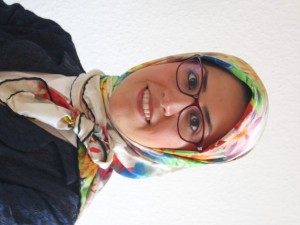
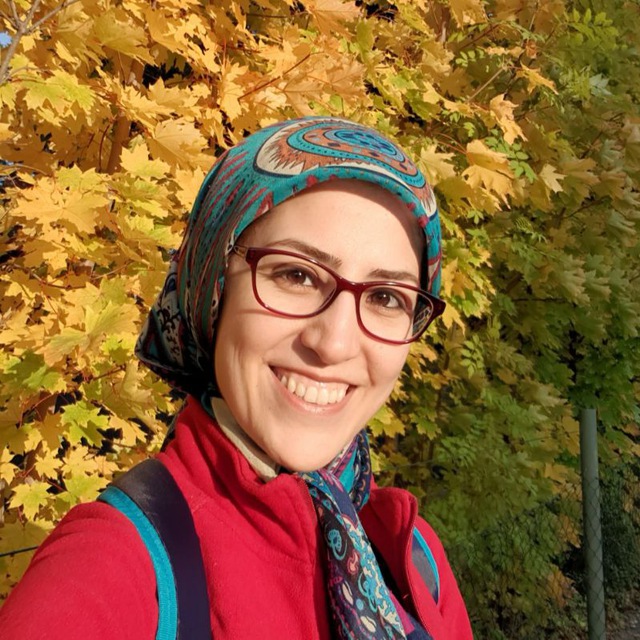
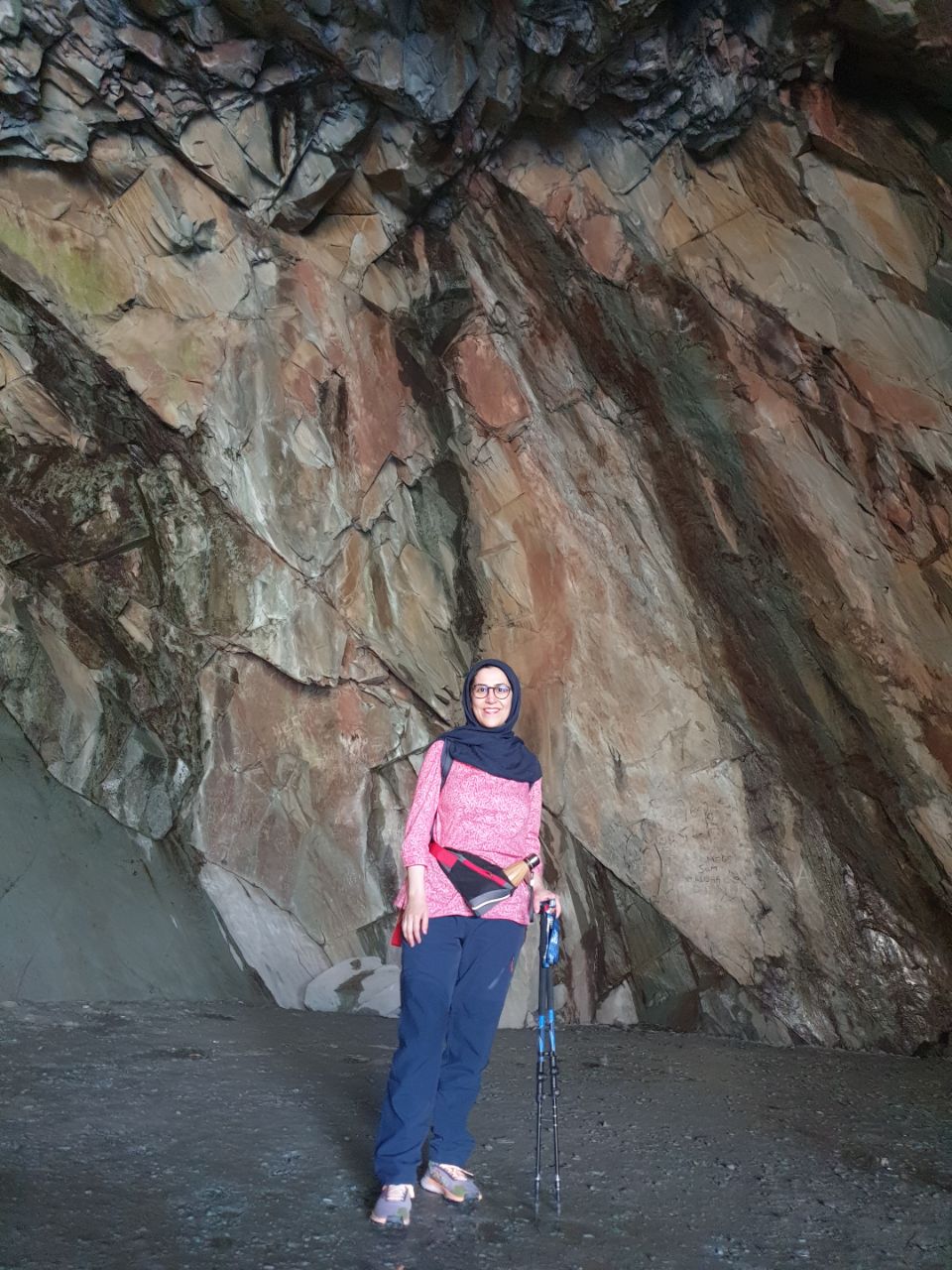
Hi there! I’m Roya, an astronomer, researcher, and nature lover.
My Passion
I’m passionate about exploring the universe—not just scientifically,
but also in a deeper, more existential way. I love trying to understand
not only the cosmos but also the meaningful connections between science,
life, and our place in it all. For me research isn’t just about discovering new things — it’s a journey
toward truth, understanding, and meaningful connections.
Beyond Science
I really enjoy connecting with people and spending
quality time together. I love physical activities and enjoy everything from yoga, pilates,
and group strength training to team sports, hiking, and fun water activities.
I also have a creative side—cooking, Persian calligraphy, painting, and crafting
are some of my favorite ways to spend my leisure time.
Fun Fact
It took me a while to get into reading more books, but about
five years ago, I finally fell in love with them!
Location: Kölner Grüngürtel, Germany
Location: Lake District, UK
So welcome to my little corner of the internet!
Here, you’ll mostly find my scientific work, but there’s a lot more
to me than just that—and I’m really happy you’re here to get to know me a bit better.
Research
My astronomy research experience spans three main phases: my current postdoctoral work, Ph.D. research, and
Master's studies. While each stage focuses on a different aspect of star formation and galaxy evolution,
they all contribute to a broader understanding of how stars form and evolve in low-metallicity environments.
All of these projects are ongoing and continue to shape my scientific journey.
You can find a full list of my publications in my
ADS Library.
1. Current Research
Building on the findings from my Ph.D. research, I’m now leading new projects and collaborating with other researchers
to explore how metallicity and environmental conditions influence star formation and its chemical signatures
on a broader scale.
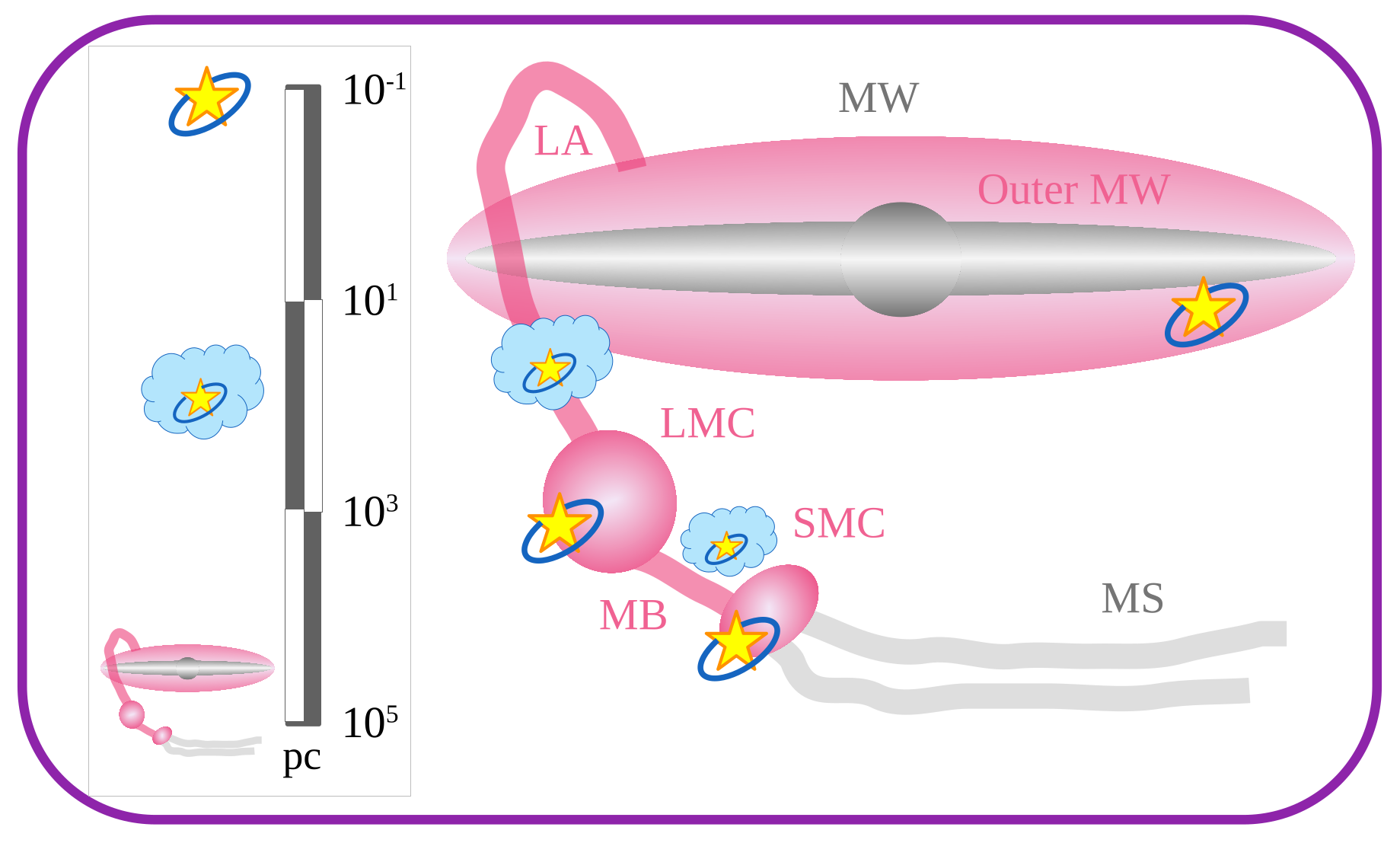
Schematic view of the Magellanic System (the LMC, SMC, Leading Arm (LA), Magellanic Bridge(MB), and the Magellanic
Stream (MS)) in relation to the Milky Way. The pink highlighted regions indicate the areas targeted in my research:
the LMC, SMC, and the outer Galaxy serve as laboratories to investigate gas infall and accretion at sub-parsec
scales, while the LA and MB are examined as potential sites of molecular cloud formation and star formation in
extremely low-metallicity environments.
The schematic was developed as part of a Marie Skłodowska-Curie Fellowship proposal (2025-2026), led by me and
awarded a Seal of Excellence (87/100).
1.1 Complex Chemistry in Low-Metallicity Environments
As part of a collaborative effort, I’m currently involved in a project focused on identifying more hot molecular cores
in the Magellanic Clouds. We're working on measuring metallicity in their local environments and,
where possible, comparing gas-phase and dust-grain surface abundances. The aim is to expand the statistical sample
of these objects and explore their chemical composition—ultimately deepening our understanding of how complex chemistry
unfolds under low-metallicity conditions (
Sewilo et al. 2025,
Broadmeadow et al. 2025).
1.2 Rotating Structures in Dense Cores
I'm investigating kinematic signatures of rotating structures associated with dense cores in the Magellanic Clouds.
This study sheds light on angular momentum transport and disk formation in environments
with reduced dust and metal content.
1.3 Molecular Clouds in the Leading Arm
I'm currently leading a search to detect and characterize molecular clouds in the Leading Arm
of the Magellanic System—an extremely low-metallicity and dynamically disturbed region.
This offers a unique window into early-stage molecular cloud formation under extreme conditions.
2. Ph.D. Research – Early Star Formation in the LMC
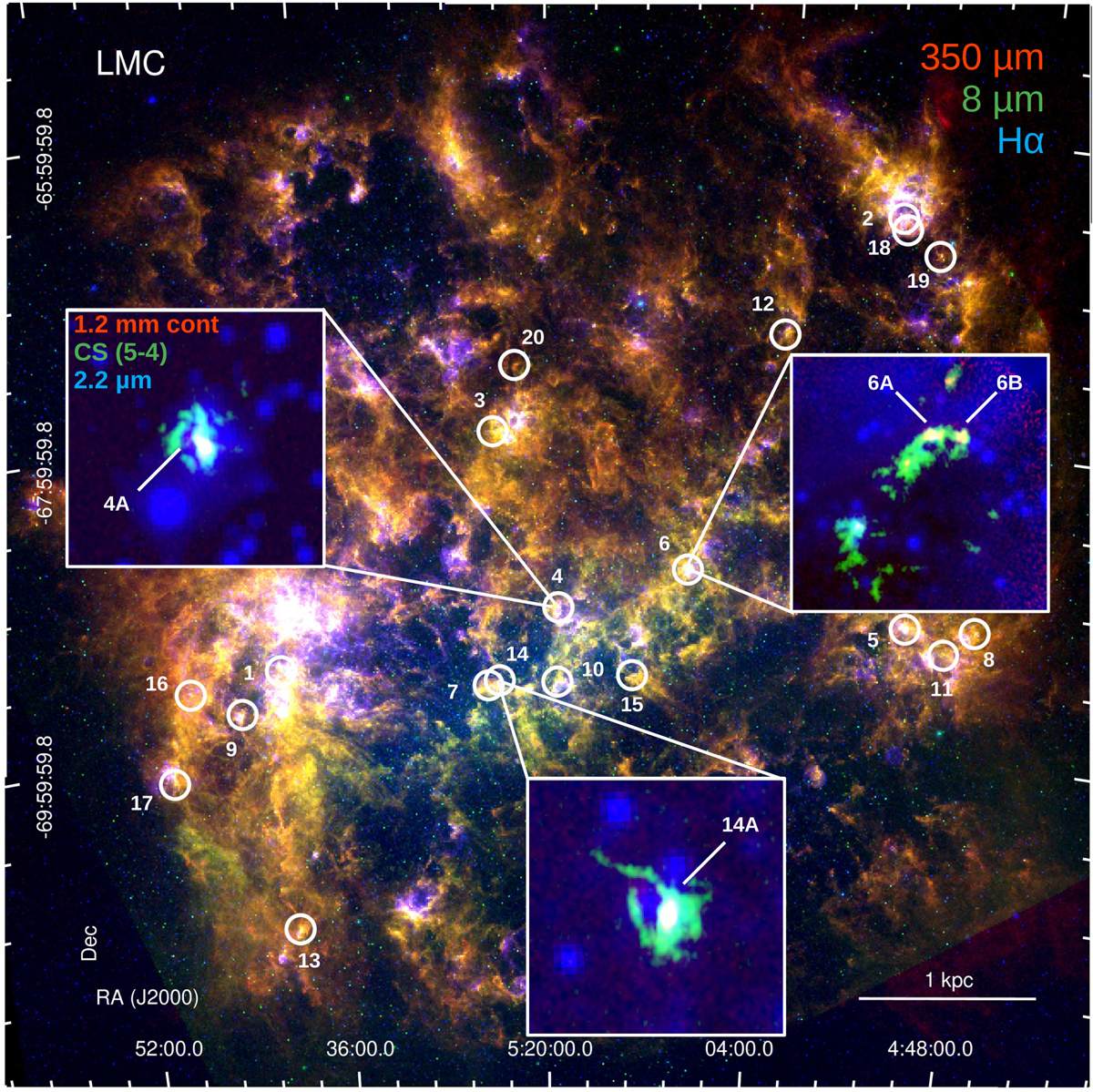
My Ph.D. focused on a comprehensive survey of 20 star-forming regions in the Large Magellanic Cloud (LMC).
The goal was to understand the early stages of star formation in a low-metallicity galaxy.
Read my thesis.
Multi-wavelength view of the Large Magellanic Cloud (LMC), combining optical, infrared, and submillimetre observations.
The positions of 20 ALMA fields are marked, highlighting the regions studied in this project.
Inset panels show selected regions with detected hot cores traced by ALMA and complementary infrared data.
For full details on the datasets and analysis, see Hamedani Golshan et al. (2024).
2.1 Physical Properties of Dense Cores and Clusters
Using ALMA millimeter data, I derived core masses, densities, and spatial distribution to study clustering
and fragmentation in young star-forming regions.
2.2 Chemical Properties of Dense Cores
I analyzed the chemical inventory of dense cores, to understand the molecular richness of the prestellar
cores in the LMC (Hamedani Golshan et al. 2024).
2.3 Morphology, Feedback, and Evolution
I studied the morphology of dense gas by identifying filamentary structures within each region.
Feedback signatures—such as molecular outflows and H II regions—were also detected.
By integrating these findings with multi-wavelength observations of the star forming regions and their immediate surroundings,
I proposed an evolutionary sequence for the 20 star-forming regions surveyed.
3. Master’s Research – AGB Stars in Dwarf Galaxies
During my Master’s, I studied the population of asymptotic giant branch (AGB) stars in Local Group dwarf galaxies
to infer star formation histories and dust contributions from low- to intermediate-mass stars.
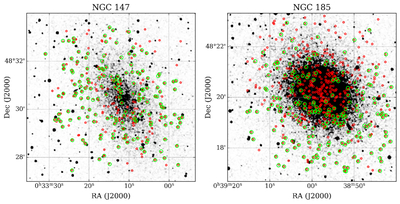
Distribution of long-period variable stars in the galaxies NGC 147 and NGC 185.
LPV stars are shown in red, while stars with available mid-infrared measurements are shown in green
(Mahani et al. 2025).
3.1 Star Formation History
I used near-infrared photometry and stellar evolution models to reconstruct the star formation history
in galaxies like NGC 147 and NGC 185, focusing on late-type stars
(Hamedani Golshan et al. 2017).
3.2 Dust Input from AGB Stars
By modeling the spectral energy distributions of AGB stars,
we estimated the dust input from these evolved stars and its contribution to the overall dust budget
of the galaxies (Mahani et al. 2025).
I have provided professional and personal coaching to several individuals in 2025.
If you feel this may be helpful for you, or if the experiences of those I have supported resonate with you,
you are welcome to reach out.
Ombudsperson for Anti-Discrimination Board
Acknowledging the needs of our community at the Physics Department of University of Cologne,
I served as an active member of the board from 2022 to 2025.
During this time, I led the organizition of a mental health event on crisis management.
Public Outreach
Projects
ZagrosRISE project
In 2025, I served as a project co-lead for the
ZagrosRISE public outreach initiative
(Project Lead:
Dr. Sajjad Mahdizadeh ), focused on Sun and solar energy for rural communities in the Zagros region
(along with several additional sites). The project aimed to foster sustainable change by integrating
solar energy and community education. Read more:
IAU OAD ZagrosRISE project .
ZagrosRISE short report:
Astronomy On Tap Köln
In early 2020, two fellow peers and I initiated Astronomy on Tap Köln, which was first launched as a series of
online events streamed via the
Astronomy on Tap Köln YouTube channel , bringing astronomy to the public, and later continued in pubs in
the city of Cologne, Germany.
General updates and outreach were shared via our
Instagram page .
I have mainly worked on event planning, poster design, and occasionally moderating sessions.
We also organized solar eclipse event during the pandemic.
While I remain in close contact with the expanded Astronomy on Tap core team, we handed over responsibilities
to new PhD students in early 2024.
This is bold and this is strong. This is
italic and this is emphasized. This is
superscript text and this is subscript text.
This is underlined and this is code:
for (;;) { ... }. Finally,
this is a link.
Heading Level 2
Heading Level 3
Heading Level 4
Heading Level 5
Heading Level 6
Blockquote
Fringilla nisl. Donec accumsan interdum nisi, quis tincidunt felis
sagittis eget tempus euismod. Vestibulum ante ipsum primis in
faucibus vestibulum. Blandit adipiscing eu felis iaculis volutpat
ac adipiscing accumsan faucibus. Vestibulum ante ipsum primis in
faucibus lorem ipsum dolor sit amet nullam adipiscing eu felis.
Preformatted
i = 0;

while (!deck.isInOrder()) {
    print 'Iteration ' + i;
    deck.shuffle();
    i++;
}

print 'It took ' + i + ' iterations to sort the deck.';